It would be easy to assume that handwriting is on its way out. Children grow up swiping screens before they hold a pencil. Schools invest in tablets and laptops. The argument for typing over writing seems obvious: it is faster, neater and more practical for the world children will enter.
But the research tells a different story. And it is one that parents and teachers need to hear.
What happens in the brain when children write by hand
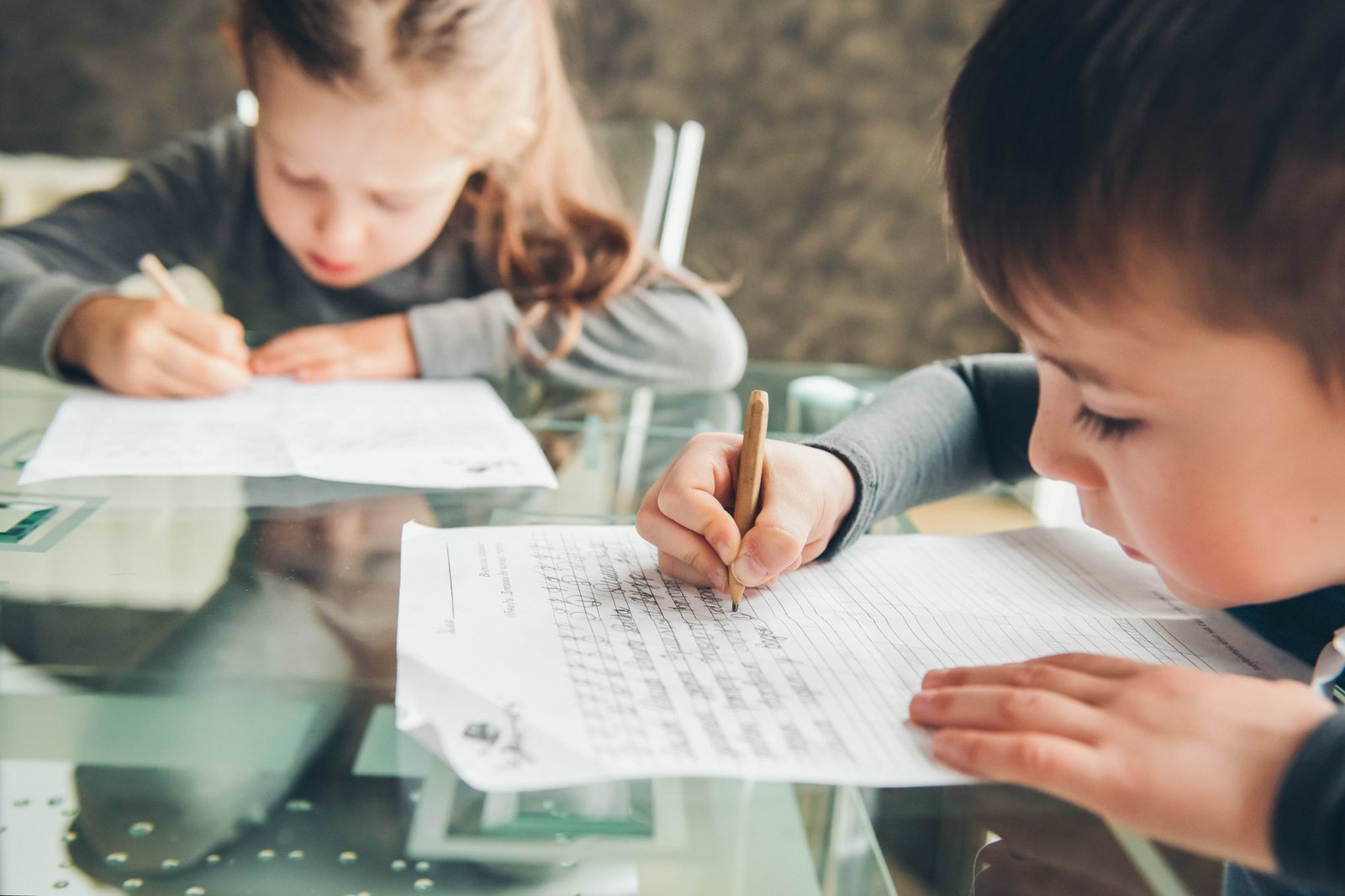
When a child forms a letter with a pencil, the brain does something it does not do when typing. It activates areas responsible for reading, memory and idea generation simultaneously. A 2012 study by Karin James at Indiana University found that children who practised writing letters by hand showed far greater neural activation than those who typed or traced them. The act of forming each letter — deciding where to start, which direction to move, how much pressure to apply — engages the brain in ways that pressing a key simply cannot replicate.
More recent research from the Norwegian University of Science and Technology, published in 2024, confirmed that handwriting activates patterns of brain connectivity associated with deeper learning. The study used high-density EEG to measure brain activity in university students. The conclusion was clear: handwriting gives the brain a workout that typing does not.
Memory, comprehension and the handwriting advantage
The benefits extend well beyond letter formation. A widely cited 2014 study by Mueller and Oppenheimer at Princeton found that students who took notes by hand performed better on conceptual questions than those who typed, though subsequent replication studies have produced mixed results. The proposed explanation is telling. Typing encourages verbatim transcription. Handwriting forces the brain to process, summarise and rephrase in real time because the hand cannot keep pace with the spoken word. That processing is where learning lives.
For younger children, the connection between handwriting and reading development is equally powerful. Learning to write letters reinforces the ability to recognise them. The motor memory of forming a letter creates a physical trace in the brain that supports recall. This is why the Department for Education’s curriculum places such emphasis on handwriting in the early years and throughout primary school.
The concern: are children losing this skill?
Teachers across the country report that children are arriving at school with weaker fine motor skills than previous generations. Reduced time spent drawing, threading, cutting and manipulating small objects means that many children are not physically prepared for the demands of handwriting when they reach Reception.
This is not about blaming screens. It is about recognising that the activities which build hand strength, coordination and pencil control need deliberate time and attention — at home and in the classroom. A child who struggles with the physical act of writing will struggle to express ideas on paper, regardless of how capable they are intellectually.
What parents and teachers can do
The good news is that handwriting is a skill, not a talent. It can be taught, practised and improved at every stage.
For the youngest children, aged two and a half to three and a half, early mark-making is the foundation. Scribbles, drawings and experiments with different tools all build the motor pathways that formal handwriting will later depend on. Recognising where a child sits on that developmental journey is the first step to supporting them effectively.
For primary-aged children, regular and focused handwriting practice makes a measurable difference. Using the right tools to identify specific difficulties — whether with letter formation, automaticity, spacing or joins — allows parents and teachers to target support where it is needed rather than relying on general practice alone.
For older children and teenagers, fluent handwriting remains essential for exams, note-taking and the cognitive benefits that come with writing by hand. Speed and legibility matter, and both can be improved with the right guidance.
Handwriting is not a relic
The digital world is here to stay. Children will type, swipe and dictate throughout their lives. But handwriting is not in competition with technology. It is a complement to it — a fundamental skill that supports reading, strengthens memory, deepens learning and gives children a means of expression that is uniquely their own.
The pen is not just mightier than the keyboard. For developing brains, it is essential.
More Handwriting provides AI-powered handwriting tools for children aged two and a half to sixteen. Our Early Writing Starter helps parents understand their child’s mark-making development from age two and a half. Our handwriting tools identify specific areas for improvement across letter formation, automaticity and fluency for children in Key Stage 1 and Key Stage 2. Find out more at morehandwriting.co.uk.