By Yvette Reinfor, Founder of More Handwriting
On 27 March 2026, the UK government published its first official guidance on screen time for children under five. The advice is clear: no screen time for children under two (except shared activities like video calls), and no more than one hour a day for children aged two to five.
The full guidance is available on the Best Start in Life website.
For parents of young children, this raises an obvious question: if children should be spending less time on screens, what should they be doing instead?
Why the guidance matters
The guidance was developed by an expert panel co-chaired by the Children’s Commissioner, Dame Rachel de Souza, and Professor Russell Viner, a paediatrician at University College London. It is based on a review of the latest evidence on how screen use affects young children’s development.
The key findings are straightforward. Long periods of solo screen use can crowd out the activities that matter most for young brains: sleep, physical movement, creative play and interaction with adults. Ninety per cent of a child’s brain development happens before the age of five. How that time is spent shapes everything that follows.
The guidance specifically recommends avoiding AI toys, tools and chatbots for young children until more evidence is available on how they affect development.
What young children need instead
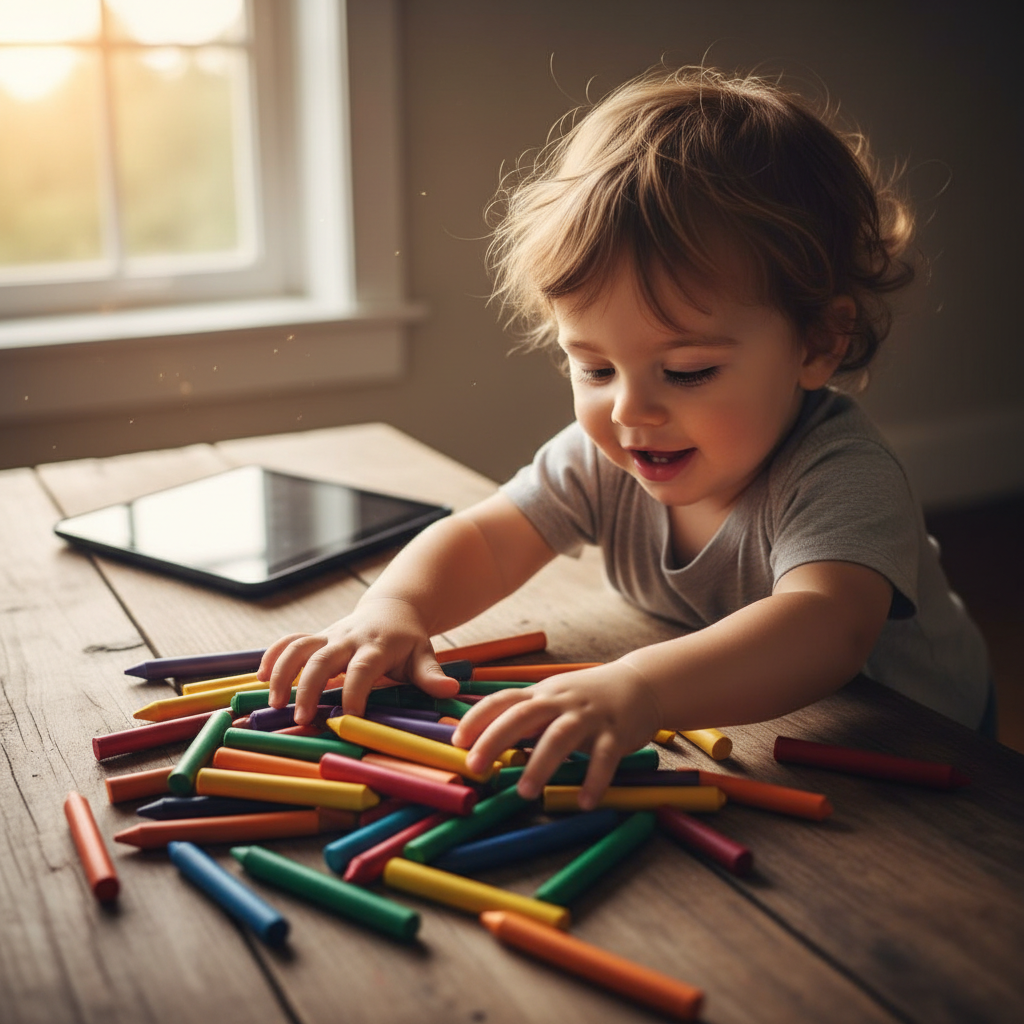
The evidence points to hands-on, physical, interactive experiences. Drawing. Painting. Building. And making marks — the kind of scribbling that two and three-year-olds do naturally when given crayons and paper.
This is not idle play. Research published in Cognitive Development has shown that children as young as two and a half begin to make different marks when they think they are writing compared to when they are drawing. This is a cognitive milestone — the first sign that a child understands that writing and drawing are different symbol systems. It is the foundation for everything that follows in literacy development.
A child making marks with a crayon is not just keeping busy. They are building the neural and cognitive groundwork for reading and writing.
The handwriting connection
The new guidance aligns with a growing body of research showing that writing by hand activates parts of the brain that screens and keyboards do not reach. Studies have found that children who learn letters through handwriting develop stronger reading and writing skills than those who learn by typing. The physical, hands-on nature of writing — the grip, the pressure, the movement — engages the brain in ways that tapping a screen cannot replicate.
For parents following the new guidance and looking for screen-free activities, mark-making and early writing are among the most valuable things a young child can do. Not because they will produce neat letters — they will not, and they should not be expected to — but because the process of making marks builds connections in the brain that support learning.
What you can do today
Keep crayons, pencils and paper somewhere your child can reach them. Do not worry about what the marks look like. Let them see you writing — a shopping list, a birthday card, a note on the fridge. Talk about what writing is for.
If your child is between two and a half and three and a half, you might be curious about whether they have reached the writing-drawing milestone. The Scribble Report is a 10-minute activity you do at home with crayons and paper. It tells you exactly where your child is – grounded in the same peer-reviewed research that informs the developmental evidence base.
The government is right to limit screen time for young children. The question is what replaces it. Handwriting — or rather, the mark-making that leads to handwriting — is one of the best answers the research has to offer.
More Handwriting creates tools for parents and schools that are grounded in developmental research. Visit our homepage to learn more.