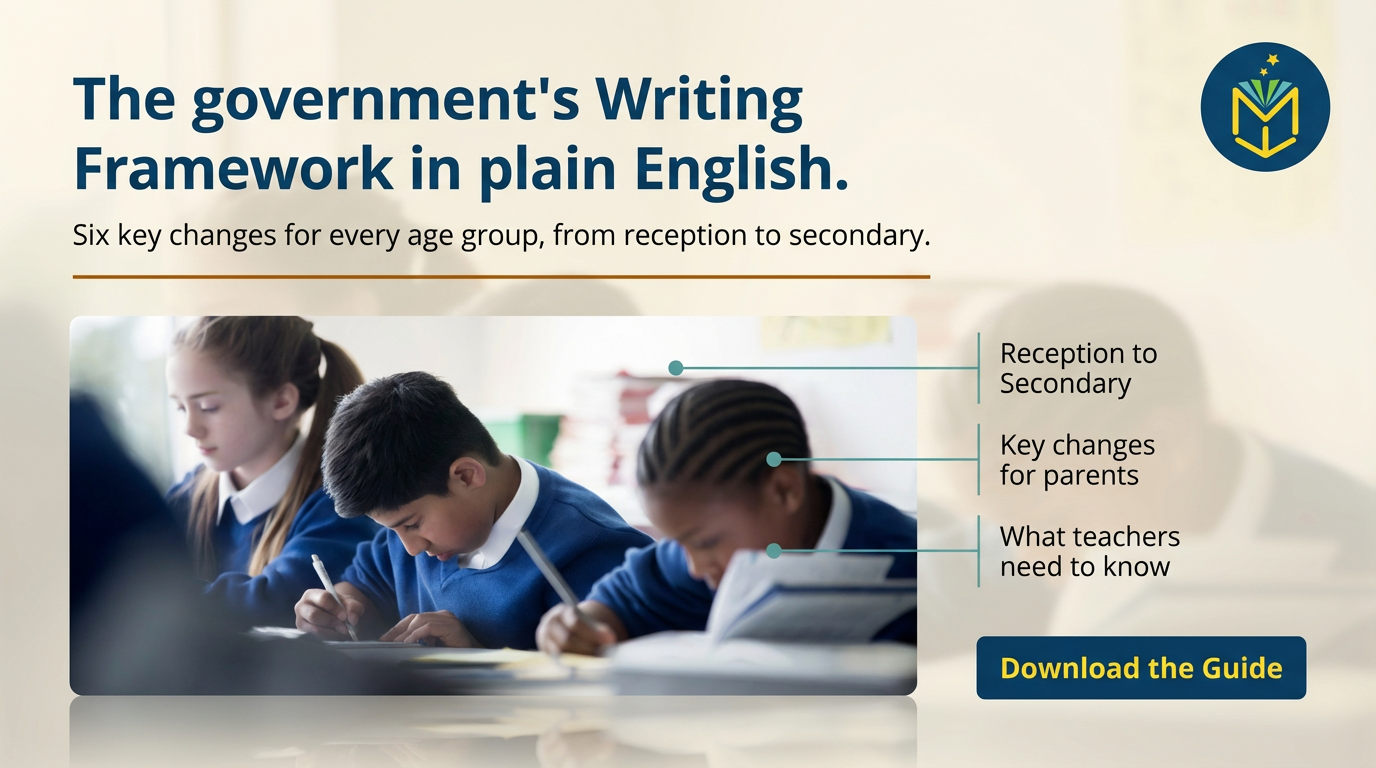
In July 2025, the Department for Education published The Writing Framework — 150 pages of guidance on how primary schools should teach writing, from reception through to Year 6 and beyond.
It is the most detailed government guidance on teaching writing in years, covering handwriting, spelling, sentence mastery, grammar, the writing process, and how to support children who struggle. It aligns with the Curriculum and Assessment Review and Ofsted’s education inspection framework.
Whether you are a parent or a teacher, there are things in this document that will affect your child or your classroom. We have read all 150 pages and broken it down into the six key changes for each age group.
The headlines
Handwriting starts from day one. The framework recommends explicit handwriting instruction from the very start of reception, alongside phonics. Daily practice is the expectation, not an optional extra.
Sentence mastery before paragraphs. The best way to teach children to write, according to the framework, is to teach them to master sentences first. Extended writing comes later, once sentence-level skills are secure.
Talk is the foundation. Children learn to compose by speaking before they write. Oral composition — saying aloud what you want to write — is central to the framework’s approach, particularly in reception and Key Stage 1.
Grammar in context. The framework warns against teaching grammar as isolated exercises. Grammar and punctuation should be taught as tools for making meaning within actual writing.
Writing assessment is changing. The Curriculum and Assessment Review is looking at how writing is assessed at Key Stage 2, with a greater focus on fluent writing. The grammar, punctuation and spelling test remains statutory at the end of Year 6, but the framework makes clear that strong test results do not automatically mean a child can write well.
AI is not a shortcut. The framework states directly that when children let AI do the writing for them, none of the cognitive benefits of writing apply. The thinking happens through the act of writing itself.
Every child included. Children with SEND should receive and be included in writing instruction. The framework sets high expectations for every child, with smaller steps and more practice where needed.
Who is this for?
The framework is written for primary schools, but it also matters for secondary teachers (who need to understand what children should arrive with), parents (who want to know what is expected at each stage), and school leaders (who are responsible for their school’s writing culture and curriculum).
Read the full breakdown
We have broken down the framework into six key points for every audience: reception parents, KS1 parents, KS2 parents, secondary parents, SEND families, reception teachers, KS1 teachers, KS2 teachers, secondary teachers and school leaders.
Read the full interactive breakdown →
You can also download the complete guide as a free PDF.
More Handwriting provides AI-powered handwriting assessment tools for children aged 2 to 16. For parents and schools — track development, identify difficulties, and get clear guidance on next steps. Visit morehandwriting.co.uk to find out more.